
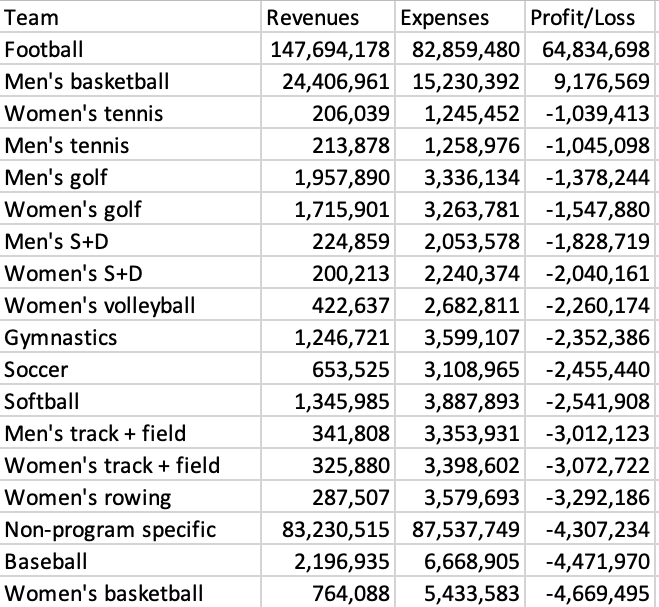
OT: University of Alabama - Profits and Losses by Sport

jessej

All-American
⭐️ Donor ⭐️
GIVING DAY 2023
HA4pvzHWMAAQAjs


About 15 years ago my first College roommate became the CFO of Temple University. He told me that part of his job consisted of preventing the AD from losing to much money. Alabama is likely an anomaly as only about 30 of the D1 Football programs turn a profit and the rest lose money. The rest of ALL football programs at all levels from D1 to NAIA all lose money.

Men's College Basketball is the only sport with the potential to be profitable on a large scale. There are less than 5 (out of 355) Women's VB Programs and less than 10 profitable women' basketball programs. Essentially any sport that you don't have to pay a ticket for is a money loser as well as sports where the average ticket price is $10 or less and/or where you see little to no corporate advertising.

He told me that they consider Football as a loss leader - hoping that Homecoming drives University Donations and a cut of that goes to the AD.

I suspect that GMU - as well as most other Universities look similar, but with GMU not having the revenue and costs associated with football, and all other profits and losses scaled down.

The AD has a tough job - profit maximization of the Men's Basketball Program and loss Minimization of the other sports, made more difficult by now having to share revenues with select sports/players.


From the article:

1770897494262.png


1770897563913.png


i.e. no fired coaches' buyouts
 

Pablo

Hall of Famer
It should be noted that he foregoing information applies to the University of Alabama's 2024-25 fiscal year prior to the start of revenue sharing on July 1, 2025.

The following provides estimates for NIL and revenue sharing for D-1 men's basketball schools for the 2025-26 fiscal year - https://nil-ncaa.com/

Basketball-e1598893142700.jpg
"NCAA basketball – average NIL & Revenue Sharing payments per team​

Let’s take a look at how this works in practice. Here are estimated 2025-26 roster costs for NCAA I basketball teams. (See our estimated roster costs for 2025 CFP Football teams farther down this page). Most large player contracts are a combination of third-party NIL and revenue sharing:


Estimated NCAA Basketball
Team Roster Cost 2025-26 *
Average Cost of
Team Roster ($)
Portion paid via
third-party NIL
Portion paid via
Revenue Sharing
SEC$ 9,700,000$ 7,100,000$ 2,600,000
Big 128,600,0004,400,0004,200,000
Big Ten8,500,0005,400,0003,100,000
ACC8,200,0004,100,0004,100,000
Big East8,000,0002,300,0005,700,000
Mid to High Majors2,300,0001,000,0001,300,000
Low to Mid Majors525,000100,000425,000
130-spacer-e1762176298408.png


* These estimates were compiled by a confidential survey of NCAA I basketball coaches conducted by the Athletic. Some notes on these estimates:

  • The SEC has the highest average per team primarily due to Kentucky’s reported $ 22 million roster cost.
  • There was a WIDE range of team roster costs – the SEC and ACC both have differences of over $ 10 million between some teams.
  • The Big East has the highest percentage of revenue sharing allocated to basketball since with the exception of UConn, no other Big East school has an FBS football program accounting for a significant amount of team specific revenue.
  • Revenue sharing began July 1, 2025 – this is also the starting date requiring submission of third-party NIL payments to the College Sports Commission for approval. Consequently, many collectives fully distributed their funds prior to July 1 to avoid having to submit these payments to the CSC for approval. Consequently, 2025 may represent a high-water mark for roster funding via NIL and 2026-27 roster costs could be lower.
The million-dollar question is will these pricey wagers buy basketball success? It will be interesting to see how Kentucky (with reportedly the most expensive roster) ends up when March Madness arrives in March 2026. One high-major coach told this to CBS Sports about the current NIL spending spree in general: 'The guys aren’t worth the money they’re going for. I could spend $15 million, but the roster I’d put together wouldn’t win a national championship. There are bad players going for big money.'”
 
Last edited:
Top